
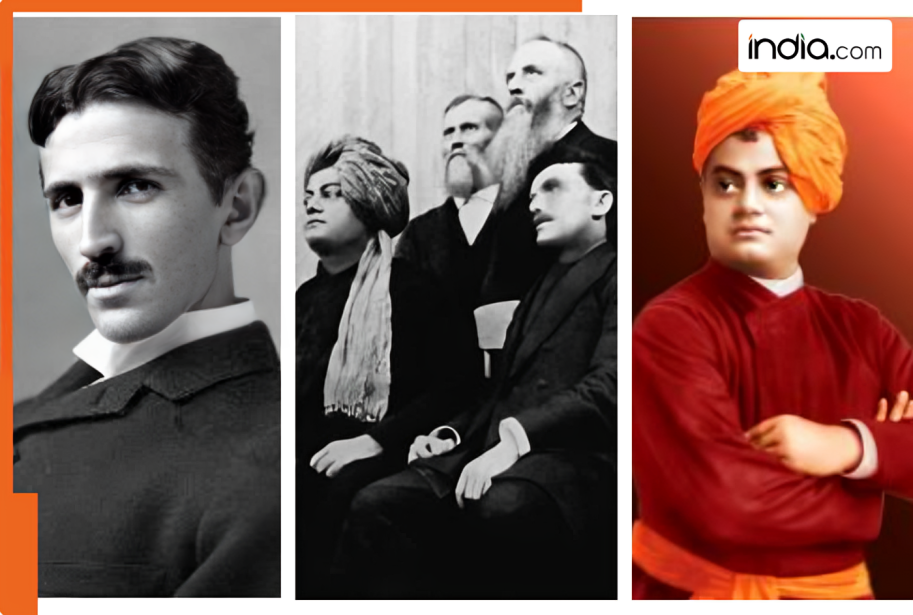
In 1893, an extraordinary meeting took place between two visionaries, Swami Vivekananda, the Indian spiritual leader, and Nikola Tesla, the brilliant inventor whose ideas shaped modern electricity. This encounter not only influenced Tesla’s thoughts on energy and matter but also bridged Eastern philosophy and Western science, offering insights that continue to inspire today.
Nikola Tesla: A Visionary Inventor
Tesla, the man behind alternating current (AC), wireless communication, and countless groundbreaking innovations, laid the foundation for much of the modern technology we rely on. However, despite his genius, Tesla died alone and penniless on January 7, 1943, overlooked by the world. Yet, 80 years later, his ideas still fasinates scientists and engineers, who strive to turn his visions into reality.
What many don’t know is that Tesla was also fascinated by spirituality and Eastern philosophy. According to Toby Grotz in ‘The Influence of Vedic Philosophy on Nikola Tesla’, this interest developed in Tesla after his meeting with Swami Vivekananda, a pivotal moment that revealed the profound connection between science and Vedantic cosmology.
Swami Vivekananda Meet Nikola Tesla
Swami Vivekananda introduced the world to Eastern philosophy during his famous speech at the 1893 Parliament of World Religions in Chicago. He spoke not only of spirituality but also of the harmony between philosophy and science. Vivekananda believed that Vedantic concepts, such as Prana (energy) and Akasha (matter), could offer a scientific foundation for understanding the universe.
In late 1895, Vivekananda expressed his hope to meet Nikola Tesla. He wrote to a friend, stating, “Mr. Tesla thinks he can demonstrate mathematically that force and matter are reducible to potential energy.” Vivekananda believed that such a demonstration would firmly establish Vedantic cosmology as scientifically valid.
According to an India Today report, the two met at a party hosted by actress Sarah Bernhardt, where Vivekananda introduced Tesla to the Vedic concepts of Prana and Akasha, as well as the idea of Kalpas (cosmic cycles). Tesla was fascinated and noted how these ideas resonated with certain scientific theories he was developing. Vivekananda later observed Tesla’s enthusiasm: “Mr. Tesla was charmed to hear about the Vedantic Prana and Akasa and the Kalpas, which, according to him, are the only theories modern science can entertain.”
Despite Tesla’s interest, he was unable to provide the mathematical proof that force and matter are reducible to potential energy. Vivekananda acknowledged this but saw the dialogue as a significant step toward integrating spirituality and science.
Swami Vivekananda On Nikola Tesla
Swami Vivekananda often spoke about Tesla’s keen interest in Vedanta, remarking during a lecture in India “I myself have been told by some of the best scientific minds of the day, how wonderfully rational the conclusions of the Vedanta are. I know of one of them personally, who scarcely has time to eat his meal, or go out of his laboratory, but who would stand by the hour to attend my lectures on the Vedanta; for, as he expresses it, they are so scientific, they so exactly harmonise with the aspirations of the age and with the conclusions to which modern science is coming at the present time”.
Legacy of Their Interaction
Although Tesla couldn’t achieve the mathematical breakthrough, the concept would later be encapsulated in Albert Einstein’s mass-energy equivalence formula, E=mc², published in 1905. Tesla’s exploration of Vedantic ideas influenced his scientific perspective and deepened his understanding of the universe.
Tesla also exchanged ideas with Lord Kelvin, a British mathematician and physicist who shared an interest in Vedic cosmology.
Their dialogue continues to inspire thinkers, demonstrating that the convergence of spirituality and science has the potential to transform humanity’s understanding of the universe.