
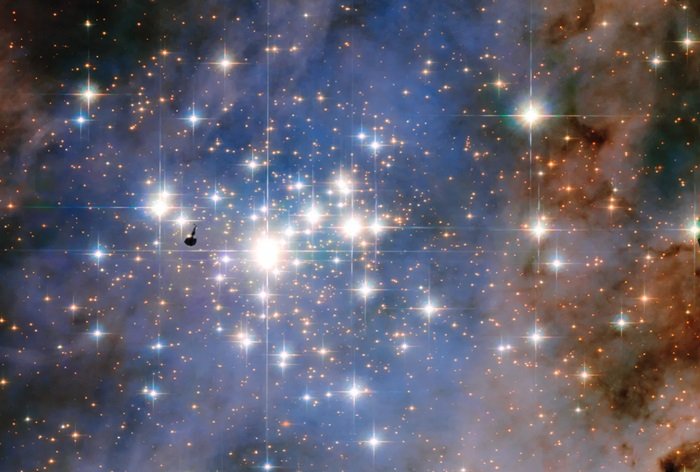
NASA recently shared a stunning image of the center of our galaxy, showcasing a massive star cluster containing over half a million stars. These stars are part of a nuclear star cluster that surrounds a supermassive black hole approximately 4 million times the mass of our Sun. Stars often form in clusters from the same nebula, and the leftover dust and gas may eventually form other celestial bodies like planets, asteroids, or comets. Gravity brings young stars together, leading them to orbit each other. Star clusters can vary significantly in size, containing anywhere from a few stars to millions. There are three main types of star clusters, and NASA’s Hubble Space Telescope has captured images of each of them over its three decades of service.
Here are the top 5 stunning images captured by NASA Hubble:
Hubble NGC 346
The Hubble Space Telescope has captured an incredible image of one of the most dynamic star-forming regions in space, located 210,000 light-years away in the Small Magellanic Cloud (SMC), a satellite galaxy of our Milky Way. At the center of this region lies the brilliant star cluster NGC 346, surrounded by arched and ragged filaments forming a striking structure with a distinct ridge.

Radiation from the hot stars in NGC 346 is carving into denser surrounding areas, creating an intricate “sculpture” of dust and gas. The dramatic, dark ridge seen in silhouette contains several small dust globules that point back toward the cluster, resembling windsocks caught in a gale, adding to the scene’s intricate detail.
Star cluster NGC 1805

NGC 1805, however, is unusual as it appears to host two different populations of stars with ages millions of years apart. Observing such clusters of stars can help astronomers understand how stars evolve, and what factors determine whether they end their lives as white dwarfs or explode as supernovae.
Star cluster NGC 1866

Star cluster NGC 1466
NASA’s Hubble Space Telescope shows NGC 1466 as an ancient globular cluster consisting of a glimmering ball of stars held together by gravity. NGC 1466 is located on the outskirts of the Large Magellanic Cloud, one of our closest galactic neighbors.
Within NGC 1466 are blue straggler stars—bright, blue stars with masses greater than the average for the cluster. These blue stragglers tend to migrate toward the cluster’s center over time due to their higher mass.

The stars closest to the core are the first to move inward, while those farther out gradually follow suit, resulting in a concentration of blue stragglers near the core.
Star cluster NGC 1651
The Hubble Space Telescope’s image of globular cluster NGC 1651 showcases a remarkable cluster located about 162,000 light-years away in the Large Magellanic Cloud (LMC), the largest and brightest of the Milky Way’s satellite galaxies. One striking aspect of this image is that NGC 1651, with a diameter of roughly 120 light-years, almost fills the entire frame.

NASA Hubble Images NGC 1651
This contrasts with other Hubble images that feature entire galaxies—spanning tens or even hundreds of millions of light-years—that similarly fill the image, highlighting the impressive resolution and capability of Hubble’s observations across vastly different scales in space.