

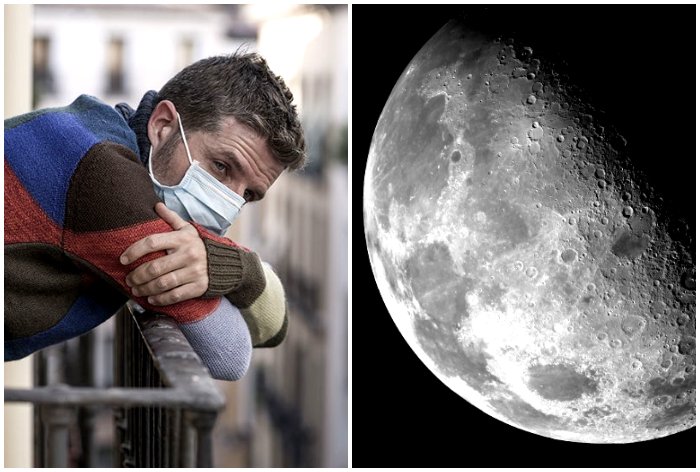
Temperature Dip On Moon Due To Covid Lockdowns: The Covid-19 pandemic has left horrific memories for people around the world. The dreadful virus claimed lakhs of lives, and even after recovering, many are still facing its aftermath. Surprisingly, the Covid-19 lockdowns of 2020 may have impacted the Moon as well. Yes, you read that right. Indian researchers have recently uncovered shocking evidence suggesting that the surface of the Moon experienced a significant temperature drop during the April-May 2020 lockdown period. The study was published in the peer-reviewed journal Monthly Notices of the Royal Astronomical Society: Letters.
The shocking and unbelievable discovery was made by scientists K Durga Prasad and G Ambily from the Physical Research Laboratory (PRL) in Ahmedabad. These scientists used and revived data from NASA’s Lunar Reconnaissance Orbiter (LRO).
How The Discovery Was Made
A team of scientists studied the nighttime surface temperature of six specific areas on the visible side of the moon. These places included a pair in Oceanus Procellarum, Mare Serenitatis, Mare Imbrium, Mare Tranquillitatis, and Mare Crisium.
Interestingly, during the lockdown in 2020, they observed a surprising dip in temperature. Comparing these findings with past records, they saw an 8-10 Kelvin (K) drop in comparison to the same period in prior years. Their detailed analysis included data from 2017 to 2023, thus covering three years before the lockdown, the lockdown year, and three years succeeding it.
In a report by TOI, Anil Bharadwaj, the head of PRL, acknowledged the significance of their findings, saying, “…This research conducted by our team here is essential. It’s quite distinctive.”
Earth’s Outgoing Radiation
Research shows that the marked drop in moon’s temperatures is tied to changes in Earth’s radiative heat loss caused by worldwide covid lockdowns. As the pandemic slowed human activities, there was a notable decrease in emissions of greenhouse gases and aerosols. This led to less heat being trapped and circulated back by the Earth’s atmosphere. Scholars infer that this decrease in Earth’s radiative performance might have had a hand in affecting our moon, which acts as a natural magnifier of Earth’s radiation traits.
“We actually analysed data for 12 years. But used seven years data (2017 to 2023) in our study for uniformity-three years before the lockdown year, 2020 and the three years thereafter,” TOI quoted Prasad as saying in the report.
Most Notable Temperature Dip On Moon Due To Covid Lockdowns
The biggest temperature plunge was recorded at Site-2 of Oceanus Procellarum, hitting a chilly 96.2 K during the 2020 lockdown. On the other side of the spectrum, the warmest we’ve ever seen at any location was 143.8 K at Site-1 in 2022 – revealing that temperatures really do vary from place to place and year to year. Still, it’s clear that 2020 was the year of record low temperatures across the board. However, as our society slowly got back to its bustling self in 2021 and 2022, so did the temperatures, showing an upward trend.
To ensure their observation these researchers also reviewed other potential contributing such as seasonal flux variations and solar activity.
More Data To Establish The Link Between Covid Lockdowns And Temperature Dip On Moon
This fascinating research hinting at a link between fluctuations in our Earth’s environmental conditions and lunar surface temperature. It is important to note, though, that the experts insist on the need for more extensive detailed data to underpin this theory. These scientists foresee that future lunar observatories could play a crucial role in observing our planet’s climate shifts and environmental evolution from a whole new vantage point – space.
The planet’s environmental challenges are becoming more and more complex. This research brings a new perspective, highlighting how interconnected our Earth’s systems are with its place in the cosmos. It also stirs up intriguing questions about the potential of using heavenly bodies, like the Moon, as vantage points to study Earth’s climate.