
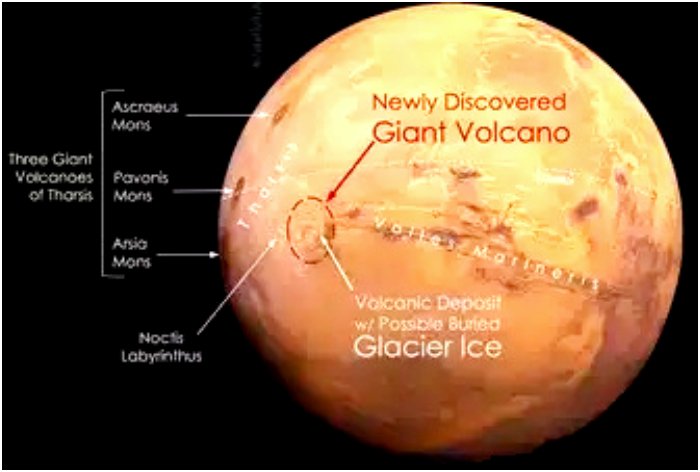
Mars: Researchers have discovered the existence of a ‘gigantic’ volcano on Mars and this discovery has captured the attention of all space enthusiasts. The massive volcano stands at 29,600 feet tall and stretches approx. 450 kilometers in width. The location of the volcano, which has been termed as ‘Noctis Volcano,’ is just south of Mars’ equator, the Eastern Noctis Labyrinthus. The researchers found the volcano using the data from a suite of missions. Including NASA’s Mariner 9, Viking Orbiter 1 and 2, Mars Global Surveyor, Mars Odyssey, and Mars Reconnaissance Orbiter. The research was also backed by the ESA’s European Space Agency’s Mars Express mission. The volcano was not detected for a long time due to its eroded state and the Martian landscape.
Massive Volcano On Mars: Potential Clues Of Life
The importance of the discovery enhances because of its gigantic size. The scientists believe that Noctis Volcano is active from ancient times because of its gigantic size and intricate modification history.
This means that the volcano could have secrets related to geologic and potentially biologic history of the Red Planet. Presence of potential sheet of buried glacier ice near the base of the volcano suggest clues to past water activity and even life.
Massive Volcano On Mars: Prime Candidate For Future Exploration
Location of the gigantic volcano which is located at the boundary between the heavily fractured Noctis Labyrinthus and the vast canyon system of Valles Marineris also makes it apt for the future exploration. The geological composition of the area is intricate and diverse, providing a data that could shed light on the history of the Red Planet. Not only that, the discovery of the volcano also highlights the possibility of other such features on the Red Planet that have yet to be detected.
Astrobiology presents a fascinating scope of possibilities. Suppose there was life on Mars. In that case, volcanic regions, like the area around the Noctis Volcano, might be crucial sites worth exploring. Just like on Earth, volcanic eruptions can lead to the creation of life-supporting hydrothermal systems. Moreover, the potential presence of glacial ice might suggest that water, a crucial element for life, exists there.
Massive Volcano On Mars: Noctis Volcano
Notably, each mission provides new information that can lead to groundbreaking discoveries such as this gigantic volcano. With new technologies it is possible that we can find more evidence of its dynamic history and, perhaps, signs of life.