

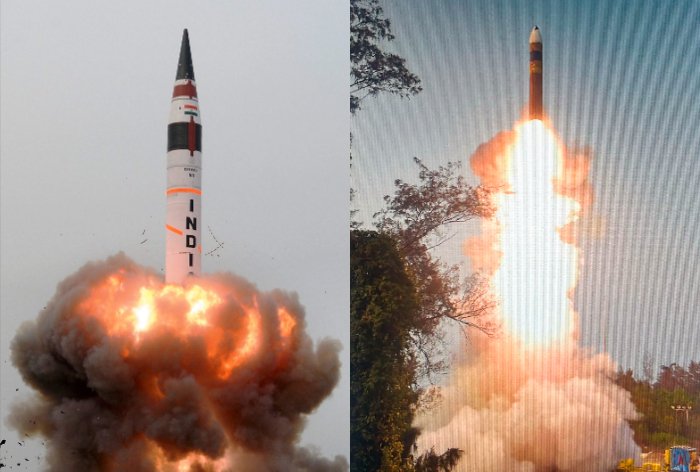
The recent development of the Agni-5 MIRV ballistic weapons system has propelled India’s second-strike capability to new heights, marking a significant milestone in the country’s defense capabilities. Dr. V K Saraswat, former Director General of DRDO and current Member of Science and Technology at NITI Aayog, described the system as offering “higher potency, better influence, and denser zone,” highlighting its strategic importance. The missile, which was a result of over a decade of meticulous development by the DRDO, successfully completed its maiden flight on Monday, placing India among a select group of nations with this advanced technology. This achievement has not only enhanced India’s geopolitical standing but has also positioned the country as a key player in southeast Asia.
Asked what this weapon would mean for India’s nuclear and missile programme, Dr Saraswat told NDTV that it will act as a “force multiplier,” expanding India’s “radius of influence” in the nuclear and missile program. “It will create a much better annihilation even with one missile. The number of missiles that will be required to be launched in future against an enemy attack would be fewer. This is called Force Multiplier,” Dr Saraswat was quoted as saying by NDTV.
This, he added, is “a major technology in terms of missile technology, control, guidance, precision”. The Agni-5 MIRV uses smaller size warheads to generate a greater effect. Dr Saraswat called it an “evolutionary process” of nuclear technology in which India is “nowhere behind”.
The system is built on Multiple Independently Targetable Re-entry Vehicle (MIRV) technology, enabling a single missile to deploy multiple nuclear warheads that can strike targets at different locations simultaneously. This advanced capability enhances India’s deterrence posture and strengthens its national security. The Agni-5 MIRV system signifies a major leap in India’s defense capabilities, showcasing the nation’s technological prowess and commitment to enhancing its strategic defense mechanisms.
About Agni-5 Missile
The Agni-5 missile, an intercontinental ballistic missile (ICBM) with a range of 5,500 to 5,800 kilometres, has marked a significant milestone in India’s strategic defence capabilities. This latest development is crucial for enhancing India’s nuclear deterrence, particularly in response to potential threats from the eastern frontiers.
Historically, India’s longest-range missile was the Agni-III, which had a limited reach of up to 3,500 kilometres. The introduction of Agni-5 fills this gap by extending the striking range to cover the extreme eastern and northeastern regions of potential adversaries.
The Agni-V missile has the ability to target almost the entire Asian continent, including the northernmost part of China, and some regions in Europe. This missile sets a new record in India’s weapons program with the farthest range achieved. Moreover, it is the first missile to be successfully launched at its maximum operational range, surpassing 5,000 km.
The recent test of the Agni-5 missile has propelled India into an elite group of nations with the Multiple Independently Targetable Reentry Vehicle (MIRV) capability.