

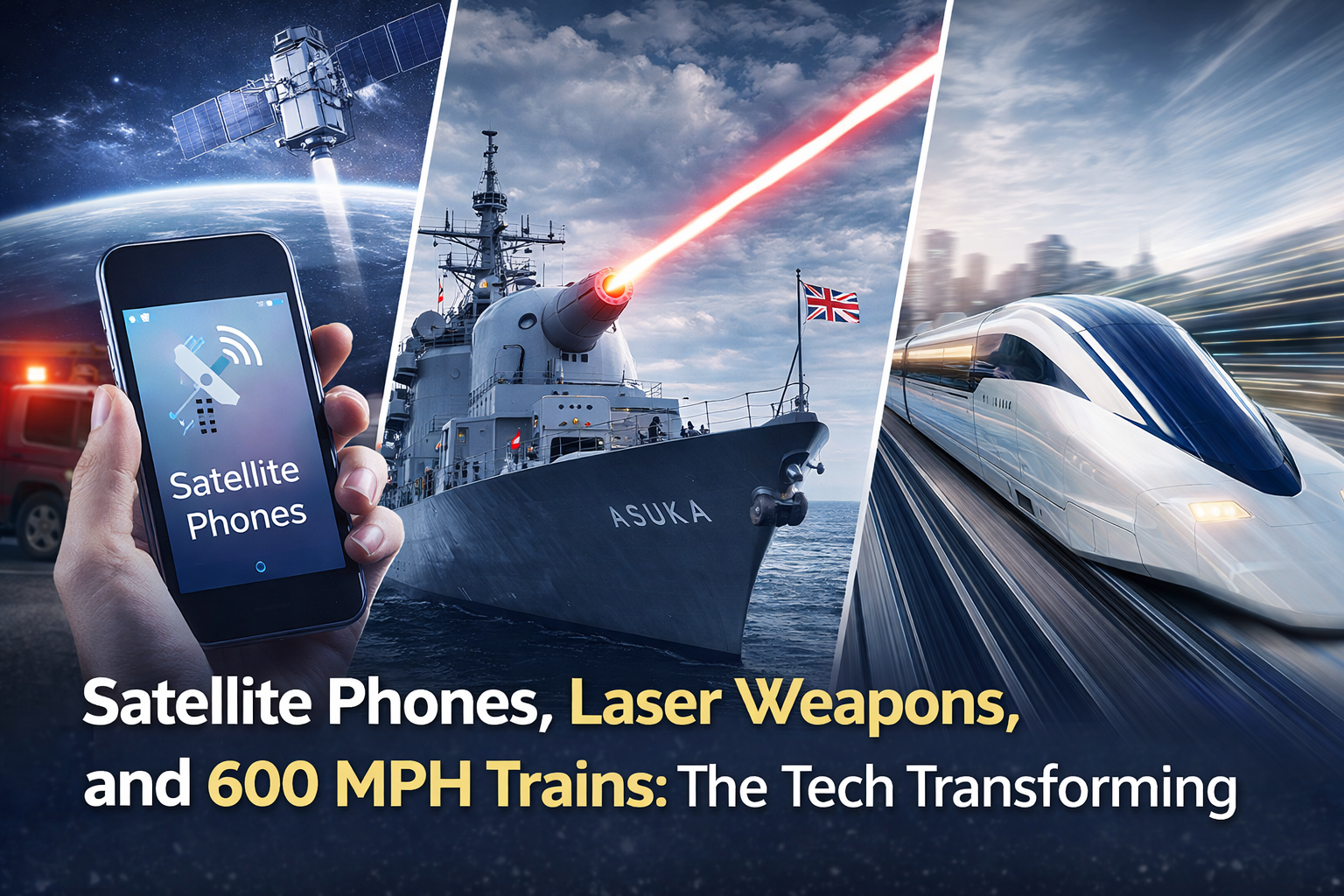
Episode 1854 kicks off with a major breakthrough in connectivity, as T-Mobile opens registration for its Starlink-powered satellite beta service. This innovation allows standard smartphones to connect directly to satellites, potentially eliminating network dead zones altogether.
The beta rollout is expected to begin in early 2026. Initially, users will be able to send text messages via satellite, with voice and data support planned for later stages. The service will be offered free to postpaid customers and will prioritize first responders. Its potential has already been demonstrated during emergency situations such as hurricanes.
The episode then shifts focus to defense technology, highlighting Japan’s successful test of a 100-kilowatt laser weapon. Installed on the JS Asuka test ship, the system merges ten fiber lasers into a single high-energy beam. Unlike traditional weapons, it offers virtually unlimited firing capability as long as power is available. Japan aims to deploy this technology on operational destroyers by 2032.
In transportation, China continues to push boundaries with its T-Flight Maglev train, which recently reached speeds of 387 mph—surpassing Japan’s current record. The long-term objective is to exceed 600 mph using advanced magnetic levitation and low-vacuum tube systems.
The discussion also explores the evolving self-driving car landscape. Rivian’s upcoming R2 model will incorporate LiDAR alongside cameras and radar, presenting a direct challenge to Tesla’s camera-only approach. This multi-sensor strategy is expected to enhance performance in challenging conditions such as fog, snow, and low-light environments.
On the software front, Google introduced Android XR, a new operating system designed for augmented reality glasses and mixed reality headsets. Samsung is developing the first compatible device, while integration with Gemini AI will enable real-time, context-aware assistance based on what users see.
Another emerging trend is the shift toward running AI models locally on personal hardware. Users are increasingly favoring this approach due to enhanced privacy, elimination of subscription costs, and the ability to operate offline.
The episode also highlights notable breakthroughs in computer science. Researchers discovered that memory systems may play a far greater role in computing than previously understood. In parallel, Google’s AI achieved gold-medal-level performance at the Math Olympiad. However, concerns remain, as studies show AI trained on poor-quality code can exhibit problematic behaviors.
Japan’s innovation in fabric-based speakers also stands out. By embedding conductive fibers into textiles, entire surfaces can vibrate to produce sound, opening new possibilities for integrating audio into everyday materials.
Finally, the episode covers several scientific developments. A new imaging technique now allows scientists to observe flu viruses infecting cells in real time. Meanwhile, Africa’s forests have shifted from absorbing carbon to emitting it, raising environmental concerns. On a lighter note, physicists successfully 3D-printed microscopic ice Christmas trees using pressure-based techniques.
The episode concludes with a holiday message, wrapping up a wide-ranging look at technologies shaping the future.