
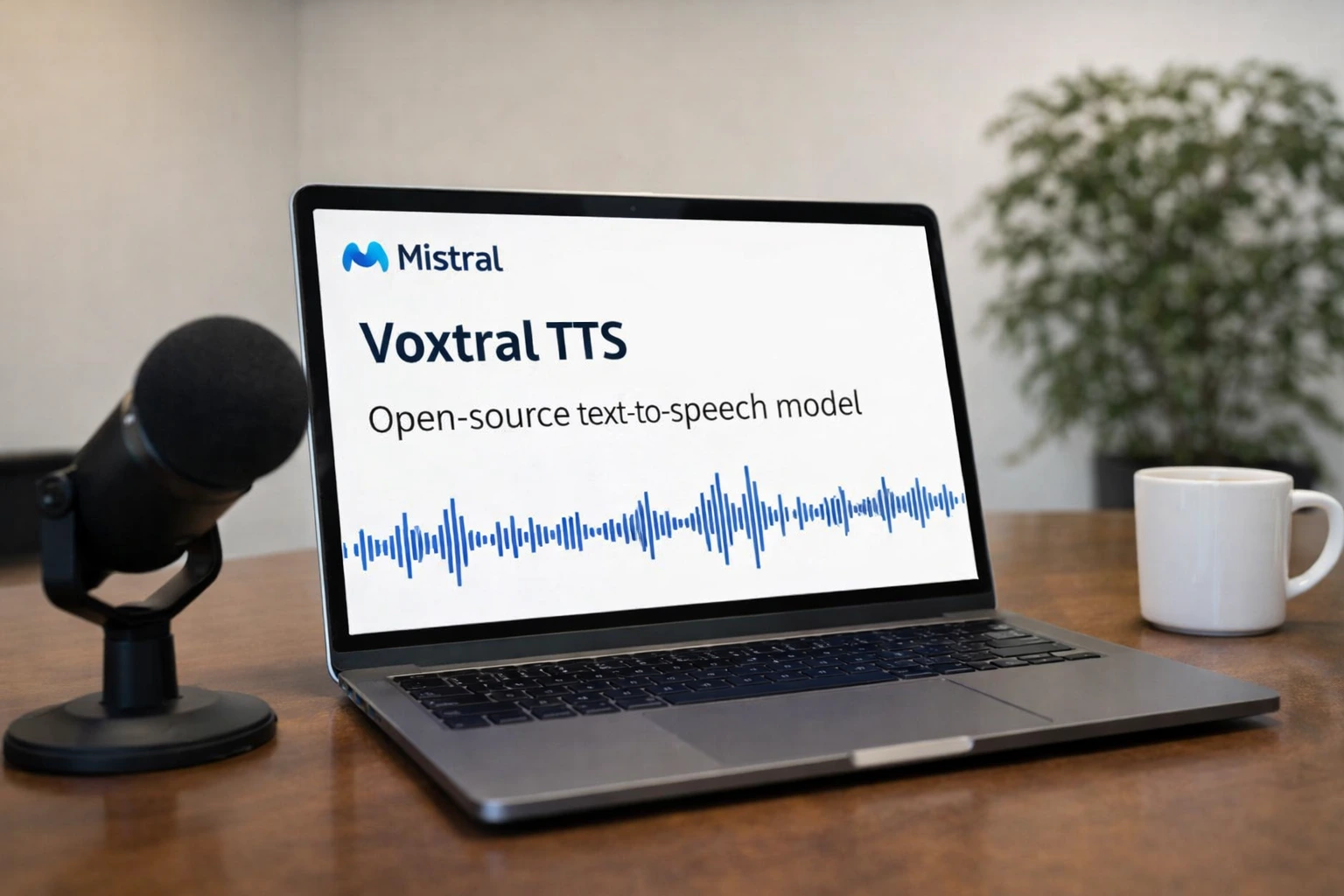
French AI company Mistral has just rolled out an exciting new open-source text-to-speech model called Voxtral TTS, marking a significant step in the booming voice AI industry. This launch positions Mistral as a serious contender against big names like ElevenLabs, Deepgram, and OpenAI.
Voxtral TTS is crafted for a variety of uses, catering to both consumers and businesses alike. Whether it’s for voice assistants, sales automation, or customer support systems, this model has got it covered. It supports nine languages—English, French, German, Spanish, Dutch, Portuguese, Italian, Hindi, and Arabic—making it a great choice for global applications.
Built for Real-Time and Edge Devices
One of the most impressive features of Voxtral TTS is its efficiency. Mistral claims that this model is lightweight enough to operate on devices such as smartphones, laptops, and even smartwatches. This gives it a significant advantage in edge computing scenarios where low latency and high performance are essential.
The model boasts quick response times, with a time-to-first-audio of just 90 milliseconds for a 500-character input. It also achieves a real-time factor of 6x, meaning it can produce a 10-second audio clip in roughly 1.6 seconds.
Advanced Voice Customization
Mistral is putting a strong emphasis on realism and customization. With Voxtral TTS, you can create a custom voice using less than five seconds of sample audio. It captures subtle nuances like accents, tone, and speech patterns, resulting in output that feels more natural and human-like.
Another standout feature is its ability to switch between languages seamlessly without compromising voice consistency. This makes it incredibly useful for applications such as dubbing, multilingual assistants, and real-time translation.
Expanding Mistral’s AI Ecosystem
The launch of Voxtral TTS follows Mistral’s earlier introduction of transcription models, signaling a broader strategy to develop a comprehensive voice AI ecosystem. The company is aiming for an `end-to-end platform capable of processing various input types, including text, audio, and images, to generate intelligent outputs.
This multimodal approach has the potential to empower more sophisticated AI agents that can manage intricate interactions across various formats.
Open Source as a Competitive Edge
Mistral is banking on the flexibility of open-source to draw in enterprise users. By giving companies the ability to customize and fine-tune the model, it offers them more control than the closed systems provided by its competitors.
This strategy could make Voxtral TTS especially attractive for businesses eager to create personalized voice solutions without being tied down to proprietary platforms.