

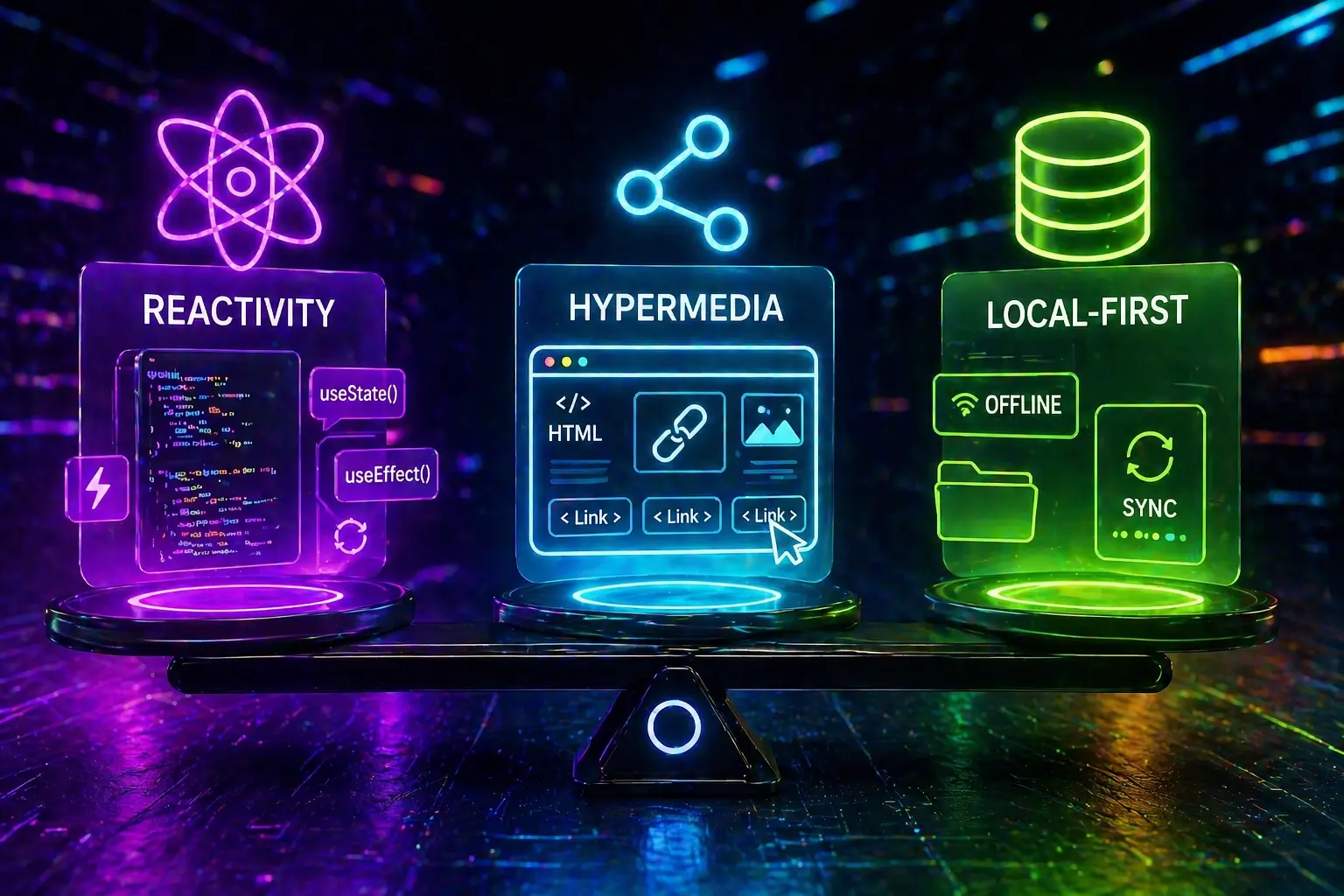
Modern web development is facing a growing challenge known as the front-end architecture trilemma—balancing reactivity, hypermedia, and local-first design. Developers are realizing that achieving all three at once is extremely difficult.
What Is the Front-End Architecture Trilemma?
The trilemma highlights a core limitation in app design: you can optimize for two of these approaches, but rarely all three simultaneously.
1. Reactivity
- Focuses on real-time updates
- Provides dynamic and responsive user interfaces
- Common in modern frameworks
2. Hypermedia
- Relies on server-driven navigation (links, APIs)
- Promotes simplicity and scalability
- Reduces client-side complexity
3. Local-First Apps
- Prioritize offline functionality
- Store and process data locally
- Improve performance and user control
Why This Trade-Off Matters
Each approach has its own strengths, but combining them creates conflicts:
- Reactivity vs Hypermedia → complexity vs simplicity
- Reactivity vs Local-first → sync and consistency challenges
- Hypermedia vs Local-first → server dependency vs offline capability
Developers must choose based on their product goals.
Real-World Impact on Developers
Modern front-end teams need to:
- Evaluate project requirements carefully
- Choose the right architectural balance
- Accept trade-offs instead of chasing perfection
There is no “one-size-fits-all” solution.
Popular Tools and Approaches
- Reactive frameworks (like modern JS frameworks)
- API-driven architectures
- Offline-first storage systems
Each aligns with different parts of the trilemma.
Why This Topic Is Trending
- Increasing complexity in web apps
- Demand for real-time and offline experiences
- Growing interest in scalable and maintainable architectures
This concept is shaping how developers design next-gen applications.
Conclusion
The front-end architecture trilemma forces developers to make strategic trade-offs between reactivity, hypermedia, and local-first design. Understanding this balance is key to building efficient and scalable applications in 2026.