
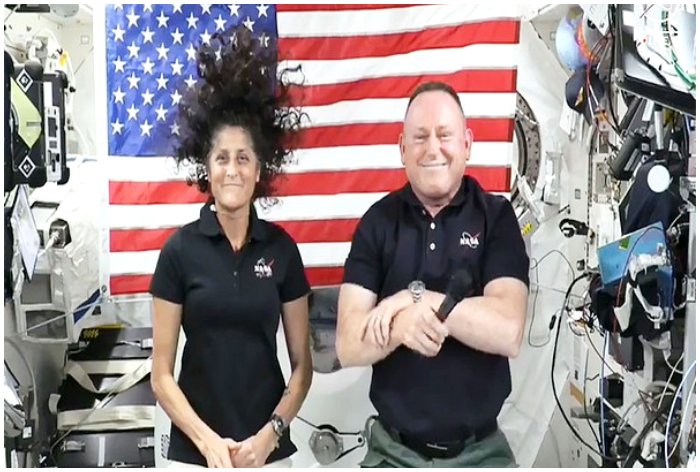
Washington DC: The American space agency, National Aeronautics and Space Administration (NASA), has clarified the situation regarding the return of astronauts Butch Wilmore and Sunita Williams to Earth, stating that it is “too risky” to bring them back at this time. NASA announced that Boeing’s Starliner capsule will return without Wilmore and Williams. Notably, both astronauts will continue their work in space as part of the expedition and are now scheduled to return on February 25. This means that their week-long test flight will be extended to around 8 months.
“Wilmore and Williams will continue their work formally as part of the Expedition 71/72 crew through February 2025. They will fly home aboard a Dragon spacecraft with two other crew members assigned to the agency’s SpaceX Crew-9 mission. Starliner is expected to depart from the space station and make a safe, controlled autonomous re-entry and landing in early September,” NASA said in a statement.
The uncrewed return of capsule will allow NASA and Boeing to continue gathering testing data on the Starliner during its upcoming flight home, while also not accepting more risk than necessary for its crew.
Wilmore and Williams, who flew to the International Space Station in June aboard NASA’s Boeing Crew Flight Test, have been supporting station research, maintenance, and Starliner system testing and data analysis, among other activities.
NASA Administrator Bill Nelson said the spaceflight is “risky” and the decision to keep the two astronauts in space and bring the Starliner unscrewed is because of “commitment to safety.”
“Spaceflight is risky, even at its safest and most routine. A test flight, by nature, is neither safe, nor routine. The decision to keep Butch and Sunita aboard the International Space Station and bring Boeing’s Starliner home uncrewed is the result of our commitment to safety: our core value and our North Star,” Nelson said. “I’m grateful to both the NASA and Boeing teams for all their incredible and detailed work.”
Notably, NASA and Boeing identified helium leaks and experienced issues with the spacecraft reaction control thrusters on June 6 as Starliner approached the space station, the agency stated.
Since then, our engineering squads have been endeavoring tirelessly, accomplishing tasks that include studying piles of data, conducting extensive tests on both land and in the air, coordinating insights with propulsion specialists within the company, and devising contingency plans in case of emergencies. Despite these efforts, the indecision and diverging opinions among the experts do not meet the safety and performance standards the agency has set for human space expeditions. Thus, the higher-ups at NASA have decided to reallocate the astronauts to the Crew-9 mission.