
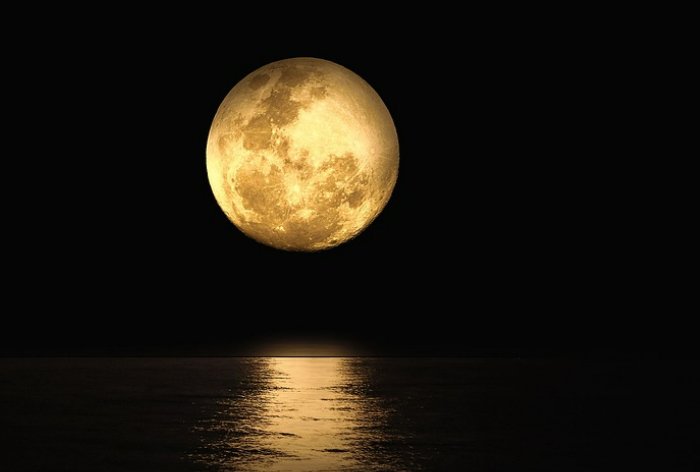
New Delhi: Don’t forget to look up tonight, as a beautiful Hunger Moon awaits you. Notably, the 24th February moon, which is a full moon, is also called a snow moon based on some historical tales. Here’s all you need to know about the ‘Hungry Moon’ or ‘Snow Moon’ and all the mysterious takes behind them.
Why Is Today’s Moon Called Snow Moon?
The lunar event carried a point from history where native american tribes used to hunt and due to the heavy snowfall in the region during this season, they could not hunt properly, leading to being ‘hungry’ and that’s how the name ‘Hungry moon’ or ‘Snow Moon’
In the central plains region, February holds the title of the snowiest month along the northeast coast, while January claims the peak month for snowfall, leading to heavy snowfall.
“Once in a while, the moon’s orbit carries it within the shadow of Earth. February’s full moon will miss the Earth’s shadow because the moon’s orbit is tilted by five degrees to the plane of the Earth’s orbit, and therefore the Earth won’t be directly between the sun and the moon,” the NDTV report said.
Where To See In US?
Starting Friday evening, you’ll be able to see the radiant Snow Moon. Its brightest point is predicted for 7:34 AM Eastern time on Saturday. If you miss the spectacle on Friday, don’t worry! Saturday night will offer another opportunity. For folks in the Washington, D.C., region, expect the moon to rise around 5:10 PM on Friday and approximately 6:10 PM on Saturday, Space.com was quoted in a report by NDTV.
According to the latest report from NASA, we’re all in for a treat on February 24th—it’s going to be a’minimoon’ or’micromoon’ night! Why? As it turns out, the moon will pop up right after its apogee, making it seem smaller than a typical ‘supermoon’. It’s fascinating, isn’t it?
6 NASA Instruments Working Fine on Moon
As the world celebrates the return of the US to the Moon after more than 50 years, the space agency NASA is elated that its science instruments and technology demonstrations are working fine on the lunar surface. Intuitive Machines’ Nova-C lander, called Odysseus, is healthy, collecting solar power and transmitting data back to the company’s mission control in Houston, US.
Carrying out six NASA science, research and technology demonstrations, Odysseus’ surface operations are underway and expected to take place through February 29. Now that they are on the lunar surface, NASA instruments will focus on investigating lunar surface interactions and radio astronomy.
‘Lunar Node 1 Navigation Demonstrator’ is a small, CubeSat-sized experiment that will demonstrate autonomous navigation that could be used by future landers, surface infrastructure, and astronauts, digitally confirming their positions on the Moon relative to other spacecraft, ground stations, or rovers on the move.
‘Laser Retroreflector Array’ is a collection of eight retroreflectors that enable precision laser ranging, which is a measurement of the distance between the orbiting or landing spacecraft and the reflector on the lander. The array is a passive optical instrument and will function as a permanent location marker on the moon for decades to come.
The ‘Radio Frequency Mass Gauge’ is a technology demonstration that measures the amount of propellant in spacecraft tanks in a low-gravity space environment. Using sensor technology, the gauge will measure the amount of cryogenic propellant in Nova-C’s fuel and oxidiser tanks, providing data that could help predict fuel usage on future missions, said NASA.
The ‘Radio-wave Observations at the Lunar Surface of the Photoelectron Sheath’ instrument will observe the Moon’s surface environment in radio frequencies, to determine how natural and human-generated activity near the surface interacts with and could interfere with science conducted there.
Stereo Cameras for Lunar Plume-Surface Studies
Another NASA instrument, ‘Stereo Cameras for Lunar Plume-Surface Studies’ is a suite of four tiny cameras to capture imagery showing how the Moon’s surface changes from interactions with the spacecraft’s engine plume during and after descent. As part of NASA’s Artemis campaign, the lunar delivery is in the region where NASA will send astronauts to search for water and other lunar resources later this decade.
(With inputs from agencies)