
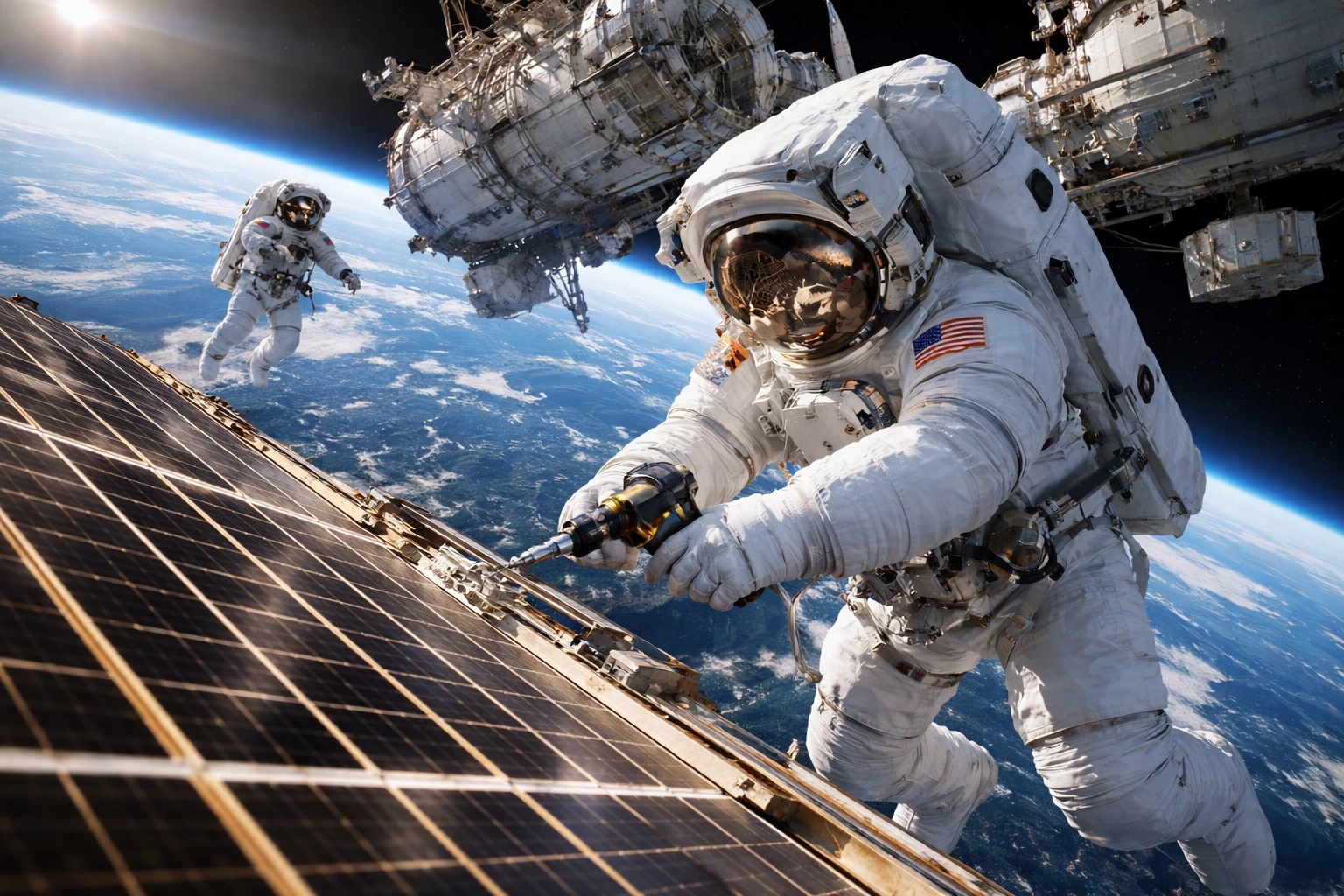
NASA astronauts successfully completed a seven-hour spacewalk aboard the International Space Station, advancing critical upgrades to the station’s ageing power system.
Mission Overview
Astronauts Jessica Meir and Chris Williams carried out Extravehicular Activity (EVA) 94 on March 18, 2026.
- Duration: 7 hours, 2 minutes
- Williams’ first spacewalk
- Meir’s fourth spacewalk
The mission focused on preparing the station for future solar power upgrades.
Key Tasks Completed
During the spacewalk, astronauts:
- Prepared the 2A power channel
- Installed an electrical jumper
- Adjusted battery system components
Some planned tasks—like collecting external samples and installing a camera lens cover—were postponed due to time constraints.
Upgrading the ISS Power System
The spacewalk is part of a broader effort to modernize the ISS:
- Original solar panels have been in use since 2000
- Designed lifespan: ~15 years
- Efficiency has declined over time
To address this, NASA is deploying roll-out solar arrays (ROSA), developed by Redwire.
What Are ROSA Panels?
ROSA (Roll-Out Solar Arrays) are:
- Compact during launch
- Designed to unroll in space
- More efficient than older panels
These upgrades will boost power generation and support future ISS operations.
Looking Ahead
Another spacewalk, EVA 95, is planned to:
- Upgrade the 3B power channel
- Continue solar array installation
These improvements are crucial for maintaining ISS functionality and planning its long-term future.