
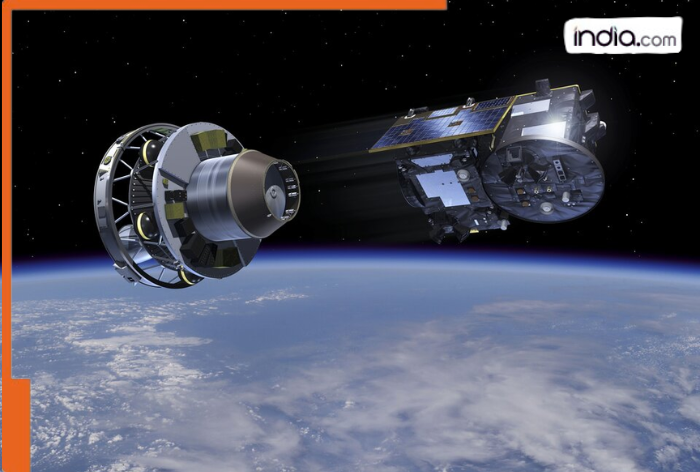
The Indian Space Research Organisation (ISRO) is scheduled to launch the European Space Agency’s Proba-3 mission (short for “Project for OnBoard Autonomy”) on December 4, 2024, at 4:08 PM IST. The launch will take place from the Satish Dhawan Space Centre (SDSC) in Sriharikota using ISRO’s PSLV-C59 rocket. The mission’s goal is to study the Sun’s outermost and hottest layer, the solar corona.
The mission will also try something new called “precision formation flying.” This means two satellites will move together in space while staying in a fixed position relative to each other.
This is the newest solar mission in the European Space Agency’s Proba series. Earlier missions, Proba-1 and Proba-2, were launched in 2001 and 2009, with Proba-1 also launched by ISRO. Scientists from Spain, Belgium, Poland, Italy, and Switzerland have collaborated to develop Proba-3.
What is the purpose of Proba-3?
Proba-3, with an estimated cost of 200 million euros (1 million euros equals approximately 9.2 crores), is planned to operate for two years. During this period, scientists aim to create around 50 artificial eclipses annually, with each eclipse lasting about six hours.
The spacecraft will be placed into a highly stretched (elliptical) orbit around Earth. At its closest point (called the perigee), it will be about 600 kilometers above Earth, and at its farthest point (called the apogee), it will reach up to 60,530 kilometers away. The orbit will have an inclination of 59 degrees, which means the spacecraft’s path is tilted at an angle of 59 degrees relative to Earth’s equator. This allows it to cover a wide range of latitudes, reaching areas farther from the equator.
This type of orbit means the spacecraft will take approximately 19.7 hours to complete one full trip around Earth.
Since the orbit is elliptical, the spacecraft will move faster when it’s closer to Earth (at perigee) and slower when it’s farther away (at apogee). This happens because of Earth’s gravitational pull, which is stronger when the spacecraft is closer.
Proba-3 is a project that has been in development for over ten years. It has been made possible with the involvement of more than 40 companies from across Europe. The Proba-3 mission is backed by 13 member countries of ESA.
Who funds Proba-3 mission ?
The 200M€ mission cost is divided as follows:
● Launch: ~30M€
● Operations and ground stations: ~15M€
● Science payload development and operations: ~15M€
● Procurement of the two spacecraft and development of formation-flying technologies: 140M€
The main contributors to the mission’s €200 million budget, under ESA’s General Support Technology Programme (GSTP), are Spain, providing 38%, and Belgium, contributing 34%. Poland and Romania each contribute about 4%, while Austria, Luxembourg, Switzerland, and the UK each contribute around 3%.
Proba-3 uses two satellites working together to create the perfect conditions for observing the Sun’s corona, which is the outermost layer of the Sun’s atmosphere. By working as a team, these satellites act like a single, very large scientific instrument. This setup allows scientists to study the Sun’s corona in greater detail than would be possible with just one satellite.
What is the purpose of using two satellites?
In the Proba-3 mission, one satellite carries a telescope, while the other, positioned about 150 meters away, blocks the Sun’s light using a special disc called an occulter. This blocks the bright sunlight and creates a shadow, allowing the telescope to clearly observe the Sun’s faint outer atmosphere, the corona, without interference.
The two satellites have to stay in the right position, with perfect accuracy, to keep the shadow in place. They need to be so precise that their positions are controlled down to just one millimeter. This is important so the telescope can clearly see the Sun’s outer atmosphere without any bright light getting in the way.
What powers the Proba-3 satellites?
Each Proba-3 satellite gets its power from high-efficiency solar panels.
Why is the mission being launched in India?
India’s PSLV-XL rocket was chosen because it can carry the combined weight of the two Proba-3 satellites, Occulter Spacecraft (weighing 200 kg) and the Coronagraph Spacecraft (weighing 340 kg) into their highly elliptical orbit. ESA’s Vega-C rocket doesn’t have enough power for this mission, and the Ariane-6 rocket would be too expensive for a mission with a limited budget focused on testing new technology.
Are the satellites controlled from the ground, or do they fly in formation on their own?
The name “Proba” stands for “Project for OnBoard Autonomy,” which means the satellites are designed to operate on their own without needing constant control from the ground. For the Proba-3 mission, the two satellites will carry out their formation flying experiments independently, using their built-in systems to stay in the correct position and work together.
What is the reason for studying the Sun’s corona?
The Sun’s corona, which is its outer atmosphere, is full of mysteries. One surprising fact is that the corona is more than a million degrees hotter (approx 1.1 million degrees Centigrade) than the Sun’s surface, the part we can see glowing from the earth. This is strange because you would normally expect things to get cooler as you move farther away from the Sun’s surface, but instead, the corona is much hotter. Scientists are still working to figure out why this happens.
Understanding the Sun’s corona is an important area of scientific research. Studying it helps scientists learn more about how the Sun works and also about solar weather, like solar storms or coronal mass ejections. These powerful bursts of energy from the Sun can impact satellites in space, disrupt communication systems, and even affect power grids here on Earth.
One of the satellites, called the Occulter Spacecraft (OSC), has a large disk that is 1.4 meters wide. This disk is designed to block the Sun’s bright light by staying perfectly aligned and perpendicular to the Sun’s rays. This creates a shadow, making it possible to study the Sun’s faint outer atmosphere, the corona, without interference from the Sun’s intense light.
How will Proba-3 create an artificial eclipse using the two satellites?
The disk on the Occulter Spacecraft will create a shadow about 8 cm wide at a distance of 150 meters. The other satellite, called the Coronagraph (CSC), carries a scientific telescope with a small opening, just 5 cm wide. This setup allows the telescope to focus on the shadowed area and study the Sun’s corona without being blinded by the bright light of the Sun.(This setup works like using a shield to block the Sun’s brightness so the telescope can see the faint outer layer of the Sun more clearly.)
This will take place when the two satellites are near the farthest point in their orbit (over 60,000 km from Earth), where Earth’s gravity is weaker. At this distance, it’s easier to keep the satellites in formation, and they use less fuel to stay in position.
When can we expect the first findings from Proba-3?
About four months after launch, once the initial testing phase is finished.
What will happen to the satellites after the mission ends?
The mission is planned to last two years. After that, the satellites’ orbit will gradually shrink because of the gravitational pull from the Sun and Moon. This will eventually cause the satellites to re-enter Earth’s atmosphere naturally, about five years after launch, following ESA’s Zero Debris policy to avoid leaving space junk.
What benefits could India gain from Proba-3?
Proba-3 is known as ESA’s technology demonstration mission. The decision to have ISRO launch the mission highlights India’s dependable space launch services and its growing expertise in space technology. This shows that India is becoming an important player in the global space industry.
One of the key features of the mission is its affordable launch.
Indian solar physicists are likely to get special access to the data from Proba-3.
Some Indian solar physicists have worked together with scientists from Belgium to help plan and develop the scientific goals of this mission. This shows India’s active role in shaping the mission’s objectives.
Shortly after the launch, India plans to hold a meeting with ESA’s Proba-3 team. The goal is to explore ways to use data from both Proba-3 and Aditya L1, India’s first mission to study the Sun (launched in 2023), for joint research. This collaboration could help scientists from both sides work together and share valuable insights about the Sun.
This would give Indians the chance to contribute to new scientific discoveries and advancements about the Sun.