
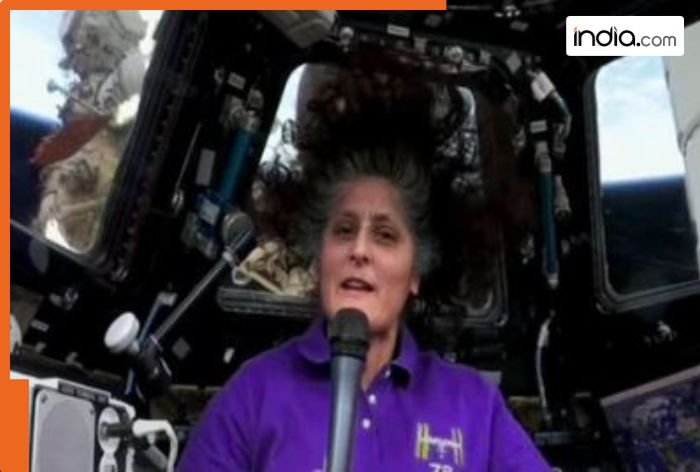
Astronaut Sunita Williams, 59, experienced significant weight loss during her 155-day stay on the International Space Station (ISS). Recent photos shared on X (formerly Twitter) have caused widespread concern, showing her with a noticeably thinner frame and sunken cheeks. This highlights how extended time in space has affected her body. Her condition has become a major focus for NASA’s health monitoring team, which is closely tracking her significant weight loss and working to improve her overall health.
Williams started her mission in June, weighing about 140 pounds (63 kg), but spending an extended time in space has caused her to lose much weight. NASA officials explained that her body needed quite a few calories and, despite her intense diet and exercise regimen, it has been difficult for her to keep her weight up. A NASA employee described her as ‘skin and bones’ and stressed that getting her health back on track was now top priority.
The Reasons For Her Weight Loss
In space, astronauts need to eat about 3,500 to 4,000 calories each day just to keep their weight stable because living in zero gravity causes their bodies to burn more calories than usual. Williams reportedly had trouble eating enough to meet this calorie requirement, which led to her quick weight loss. Once one fell behind, the weight came off fast, a NASA employee told The New York Post.
The lack of enough calories, along with over two hours of daily exercise to maintain muscle and bone strength, has put extra pressure on Williams’s health. NASA doctors have been stringently monitoring Williams’s physical condition for well over a month, even before her latest emaciated photos surfaced.
Exercise is crucial to prevent muscle loss and bone weakening in the microgravity of space, but it also burns calories quickly. This makes it hard for astronauts to keep up with their calorie needs, especially with the limited food supplies available on the ISS.
For female astronauts, the challenges can be even tougher. Research shows women tend to lose muscle mass faster than men during space missions, partly because of differences in how their bodies process energy. A 2023 NASA study highlighted the specific physical effects space has on women.
Key Challenges for Human Body
Ø Scene 1
Changes that happen to one’s body in space
§ Many people experience ‘space sickness’
Space has a much weaker gravitational force than Earth. This can lead to ‘space sickness’ for many, causing such symptoms as headaches, nausea and vomiting. On Earth, gravity affects people strongly and a small organ inside the inner ear, known as the vestibular organ, helps people stay balanced. The vestibular organs sense changes in gravity and acceleration, converting this information into electrical signals that are sent to the brain. Here on Earth, the brain constantly receives these signals from the vestibular organs, helping maintain a person’s balance. This process allows one to stay steady and upright, making adjustments for any movements one makes.
In the low-gravity environment of space, the signals from the vestibular organs are different from those on Earth. This change can confuse the brain, often causing astronauts to get ‘space sick’. However, space sickness does not last forever. After a few days in space, the brain starts to adapt to the new signals from the vestibular organs. This adjustment helps the brain make sense of the information and the symptoms of space sickness eventually disappear.
The intensity of space sickness varies from person to person and some do not feel it at all. When one returns to Earth, one has to adjust again to Earth’s gravity, which can cause ‘gravity sickness’. This condition can feel similar to ‘space sickness’, with symptoms that occur as your body readjusts to gravity.
International Space Station
The ISS orbits Earth at an altitude of about 400 km and moves at a speed of 28,000 km/h. Astronauts on board are moving at this same speed along with the ISS. The ISS is orbiting Earth at an altitude of ~400 kilometres only; so, the gravitational field inside the space station is still 90% of that on Earth’s surface.
On Earth, when one stands on a surface, one feels the pressure of gravity pulling one down, whereas, on board the space station, this does not happen because the entire station—along with its crew—is in a state of ‘free fall’—meaning, falling due to gravity only and no other force. As a result, the astronauts are in a state of ‘microgravity’, or ‘weightlessness’. This happens because the centrifugal force of the station’s orbital motion cancels out the force of gravity; so, the astronauts are ‘at rest’ relative to the orbiting station.
Ø Scene 2
Why do astronauts’ faces appear puffy?
§ The face often swells up in space
On Earth, gravity pulls blood and other fluids down to the lower body. In the low gravity of space, this pull weakens, causing fluids to gather in the upper body instead. This buildup of fluids in the head is why astronauts’ faces look swollen in space. The nasal membranes also swell up in space, so astronauts often experience stuffy noses. After spending some time in space, the fluids in your body gradually adjust and the facial puffiness usually starts to fade within a few weeks.
When astronauts return to Earth, they often feel dizzy when they stand up, a condition called orthostatic hypotension. This happens because Earth’s gravity is much stronger than in space, making it harder for blood to reach the head from the heart. In space, blood flows more easily, so the heart does not need to work as hard. As a result, the heart muscles may weaken, which can add to the dizziness astronauts feel back on Earth while standing.
Ø Scene 3
Spending extended time in space affects the body
§ Bones and muscles weaken
When one is in space for a long period, one’s muscles and bones, especially in the legs and lower back, tend to weaken. This happens because, in space, there is no gravity pulling one down as on Earth. On Earth, although one may not notice it, the body constantly works against gravity. Just standing or walking makes one’s muscles and bones work to support one’s weight. Without gravity in space, the body does not have to work as hard, so those muscles and bones start to lose strength over time.
Scientists are currently studying how well-existing medications can help prevent bone loss in astronauts while in space. To combat the weakening of muscles and bones, astronauts also spend about two hours each day exercising during their time on the ISS.
Ø Scene 4
Is radiation stronger in space?
§ Higher levels of radiation in outer space can significantly affect the human body
The Earth is surrounded by an atmosphere, which not only gives us the oxygen we need to breathe, but also shields living things from harmful UV rays and radiation. In space, however, there is very little atmosphere, so astronauts are exposed to much higher levels of radiation than on Earth. In just one day in space, they receive the same amount of radiation they would typically be exposed to over six months on Earth. Being exposed to high amounts of this radiation increases the risk of developing health problems, such as cancer.
Ø Scene 5
Do things other than the body change in space?
§ Living in confined spaces can cause significant stress
While the ISS offers much more room than earlier spacecraft, it is still very limited compared to life on Earth. Spending months in such a confined space with other astronauts can cause stress, often before they even realize it, as they live and work closely together.
Astronauts on the ISS come from various countries—the US, Russia, Canada, Europe and Japan. Because of this, language differences and cultural backgrounds can sometimes cause stress. To help astronauts manage stress, they are given the chance to talk with family and friends while in space and the quality of space food has been improved.
Medical Management in Space
§ On the ISS, the astronaut in charge of medical care provides treatment
Every astronaut on the ISS has a specific job and receives detailed training for that role. The astronaut responsible for handling medical emergencies is known as the Crew Medical Officer. This astronaut is trained to provide medical care if someone falls ill or gets injured while in space. The Crew Medical Officer is trained to provide more than basic first aid; they can also stitch up wounds and give injections.
The ISS has a medical kit with instruments and medicines for emergencies. All astronauts are trained in emergency resuscitation, so they know what to do if someone among the crew has a heart attack. This way, any astronaut can perform the procedure if needed at any time.
The Goal of Space Medicine
Many medical issues need to be addressed to ensure that humans can live safely in space. Space medicine focusses on studying how space affects the human body, understanding the causes and finding ways to prevent or reduce them. The goal of space medicine is to reduce the effects of space on human health and help astronauts stay healthy and physically strong while away from Earth. The technology and knowledge gained from keeping astronauts healthy in space not only address challenges of living and working in space, but can also be used to improve medical care for people on Earth.
Space medicine is built on two main premises:
o Taking care of astronauts’ health, and
o Conducting research to advance medical knowledge for space travel
These two pillars work together to ensure that astronauts stay healthy during their mission, while also exploring new ways to improve health care in space.
Taking care of astronauts’ health is a type of clinical medicine. It not only makes sure they are fit and ready for their space mission, but also helps them adjust smoothly to life back on Earth upon return. For long-term missions to the ISS, a specialized medical team looks after the astronauts’ health before, during and after their time in space.
The International Space Station Medical Operations Requirements Document outlines everything that needs to be managed to keep astronauts healthy. These include regular medical check-ups, exercise routines and monitoring the space environment. In addition, space food and everyday supplies are crucial to make sure astronauts can live well and stay healthy while in space.